Trace the complete path to the grower
A sensor network needs a route from the sensing element through logging and communications to a usable record. A radio feature alone does not provide that complete route. List the devices that record observations, forward packets, maintain time and expose the data. Check where power is supplied and who operates the service. That inventory reveals missing gateways, subscriptions and acquisition components before installation.
An integrated cellular Master can combine several roles. A wired probe or radio Node may rely on additional infrastructure. Compare the route for the actual model rather than assuming every wireless device can upload independently.
Cellular: a direct modem route
A cellular unit connects through a supported mobile service using its modem and service arrangement. Coverage at the installation point, antenna placement and compatibility with the available network are central requirements. Verify the supported technology and bands where relevant, especially when comparing older and newer hardware generations. A phone showing signal nearby is useful context, but commissioning should test the installed device.
Pycno Terra Masters combine sensing and the cellular gateway role. Our comparison distinguishes 2G and 4G options. Choose an option that is supported in the intended country and location, with the appropriate data service. Cellular simplifies the internet route but does not remove power, service or maintenance requirements.
LoRa and LoRaWAN: related but distinct
LoRa describes a radio modulation technology. LoRaWAN defines a network protocol and architecture using compatible devices, gateways and server functions. A LoRaWAN gateway forwards packets over an internet backhaul. That backhaul may itself use cellular or another connection. A private gateway and a public network therefore have different infrastructure and service responsibilities.
A proprietary LoRa system can use different messaging and management from LoRaWAN. Terra Nodes use their compatible Master; Sensoterra uses a LoRaWAN network route. Sharing the LoRa radio name does not establish interoperability. Confirm the network, frequency region and device provisioning rather than purchasing a generic gateway on that assumption.
Wi-Fi and satellite solve different coverage questions
Wi-Fi can be useful where supported equipment is within a reliable local network, such as parts of a greenhouse or farm building. Check outdoor coverage, credentials, network management and whether the equipment supports continuous uploads or a particular transfer workflow. BLE often serves nearby setup or interaction and should not be mistaken for a farm-wide internet connection.
Satellite communications can provide a data route where suitable terrestrial coverage is absent, subject to terminal design, sky visibility, power, payload and service terms. This is different from satellite remote sensing, which observes the land from orbit. A product using SMAP data is not thereby a satellite-connected field probe. Our reviewed products should only be credited with satellite connectivity when their documentation establishes it.
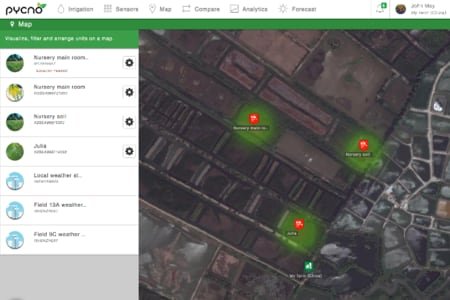
Plan outages, power and recurring costs
Ask whether readings are retained locally during an outage and how later uploads preserve timestamps. Review the energy consumed by acquisition and transmissions, then evaluate the battery or solar arrangement. Network range depends on terrain, vegetation, mounting and interference; an advertised distance is not a guarantee for every field.
Compare service costs, account access, exports and support alongside radio technology. Start with a coverage test at the intended sites and a clear response to missing uploads. The power guide, cost guide and data workflow guide complete that planning sequence.
Common questions
Will any LoRaWAN gateway work with a LoRa Node?
No. The device’s protocol, regional radio parameters and provisioning must be compatible with the chosen network.
Does wireless mean no recurring cost?
No. Check internet backhaul, network service, platform access and maintenance for the complete system.
Match the network to a defined farm decision. The guide to connected sensor adoption explains where remote observations can justify the operating cost and what can limit their value.